


Digital merchandising has changed dramatically over the past decade. Traditional ecommerce merchandising once focused mainly on manually organizing product categories, promoting seasonal collections, and placing bestselling items in visible locations. While these strategies still matter, modern digital commerce has become far more dynamic and customer-driven.
Today’s consumers expect personalized shopping experiences that adapt to their interests, browsing behavior, and purchase intent in real time. This shift has pushed retailers to move beyond static merchandising approaches and embrace intelligent automation.
At the center of this transformation is the product recommendations engine. What began as a simple cross-sell feature has evolved into a critical technology that powers personalized discovery, influences purchase decisions, and reshapes how digital merchandising works across ecommerce platforms.
The Evolution of Digital Merchandising
Digital merchandising originally mirrored physical retail merchandising.
Retailers focused on:
- Homepage product placement
- Category organization
- Promotional banners
- Seasonal campaigns
- Bestseller visibility
Merchandising decisions were often driven manually by ecommerce or marketing teams.
While effective at a broad level, these approaches lacked personalization. Every customer largely saw the same experience regardless of their preferences or shopping behavior.
As ecommerce competition increased and customer expectations evolved, this model became less effective.
The Shift Toward Personalized Merchandising
Modern shoppers expect ecommerce experiences that feel tailored to them individually.
For example:
- A fashion shopper interested in streetwear expects different recommendations than a customer shopping for formalwear
- A returning customer expects continuity based on past browsing and purchases
- Mobile shoppers expect fast and highly relevant product discovery
Static merchandising alone cannot support these expectations.
This is why retailers increasingly rely on product recommendations engines to create adaptive and personalized merchandising experiences.
What is a Product Recommendations Engine?
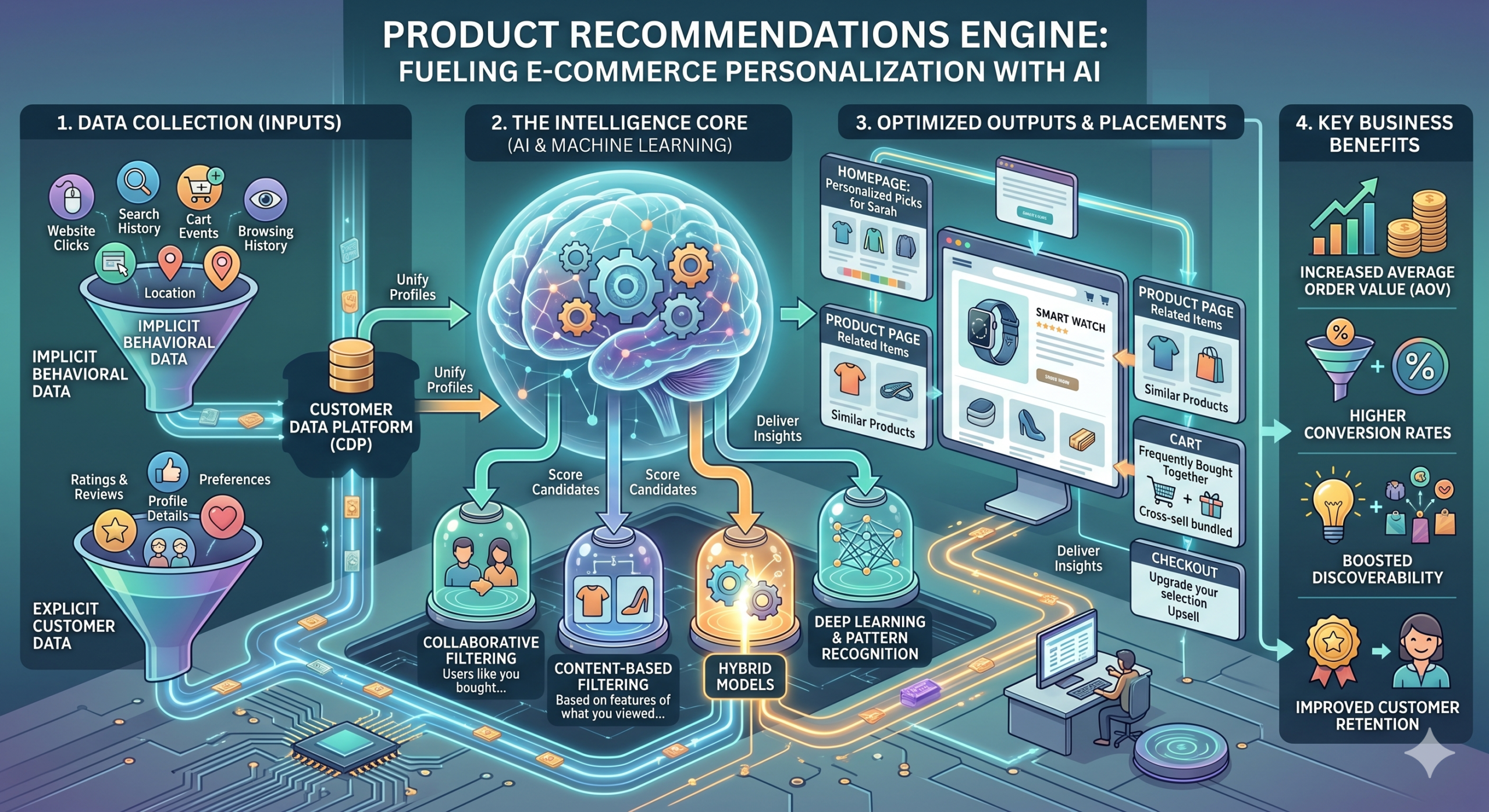
A product recommendations engine is a system that uses customer data, behavioral insights, and machine learning algorithms to suggest relevant products to shoppers.
Recommendations can be based on:
- Browsing behavior
- Purchase history
- Product affinity
- Similar customer activity
- Real-time interactions
The goal is to improve product discovery and guide customers toward products they are more likely to purchase.
How Recommendation Engines Changed Merchandising
From Manual to Automated Decision-Making
Traditional merchandising relied heavily on manual product curation.
Recommendation engines automate many merchandising decisions by analyzing customer behavior continuously and adapting product visibility dynamically.
This allows ecommerce experiences to scale more effectively.
From Static Experiences to Dynamic Personalization
Instead of showing identical product assortments to every visitor, recommendation engines personalize merchandising in real time.
Examples include:
- Personalized homepage recommendations
- Dynamic category sorting
- Individualized cross-sell suggestions
- Session-based recommendations
This creates more engaging shopping journeys.
From Product-Centric to Customer-Centric Merchandising
Traditional merchandising focused mainly on promoting products.
Modern recommendation systems focus on understanding customer intent and delivering experiences aligned with individual preferences.
This shift makes ecommerce more responsive and customer-driven.
Key Recommendation Strategies in Digital Merchandising
Frequently Bought Together
This recommendation model suggests complementary products commonly purchased together.
Examples include:
- Shoes paired with accessories
- Electronics paired with add-ons
- Beauty products bundled with related items
This improves cross-selling opportunities and increases basket size.
Similar Product Recommendations
Customers often compare products before making decisions.
Recommendation engines can suggest:
- Similar styles
- Alternative price points
- Comparable product features
This keeps shoppers engaged even if their first choice is unavailable.
Trending and Popular Products
Social proof remains important in ecommerce.
Showing trending products helps customers discover popular items while supporting merchandising goals.
Personalized Recommendations
These recommendations adapt to each customer individually based on behavior and preferences.
This is one of the most effective forms of digital merchandising because it maximizes relevance.
The Role of Real-Time Data
Modern merchandising increasingly depends on real-time customer behavior.
Recommendation engines analyze live interactions such as:
- Current browsing sessions
- Product views
- Search behavior
- Cart activity
This allows merchandising experiences to adapt instantly.
For example:
- Viewing running shoes may trigger athletic apparel recommendations
- Searching for formalwear may influence homepage content dynamically
Real-time responsiveness improves engagement and conversion rates significantly.
AI and Machine Learning in Recommendation Engines
Artificial intelligence has transformed how recommendation systems operate.
Machine learning models help:
- Predict customer preferences
- Identify behavioral patterns
- Optimize product ranking
- Improve recommendation accuracy continuously
AI enables personalization at a scale impossible through manual merchandising alone.
It also allows recommendation systems to improve over time as more customer interactions occur.
Omnichannel Digital Merchandising
Modern customers move across multiple channels throughout the shopping journey.
Recommendation engines now support merchandising across:
- Ecommerce websites
- Mobile apps
- Email campaigns
- Search experiences
- Paid advertising
For example:
- Products viewed on mobile influence email recommendations
- Website browsing impacts retargeting ads
- Search behavior shapes homepage merchandising
This creates more connected customer experiences.
Benefits of Product Recommendations Engines
Improved Product Discovery
Customers find relevant products faster and more efficiently.
Increased Conversion Rates
Relevant recommendations improve purchase likelihood.
Higher Average Order Value
Cross-sell and upsell recommendations encourage larger purchases.
Better Customer Engagement
Personalized merchandising creates more engaging experiences.
Enhanced Inventory Visibility
Recommendation engines can strategically promote underexposed products.
Challenges in Modern Digital Merchandising
Data Fragmentation
Disconnected systems reduce personalization accuracy.
Over-Personalization
Excessive filtering may limit discovery and exploration.
Scalability Requirements
Recommendation systems require strong infrastructure and data processing capabilities.
Privacy Considerations
Businesses must use customer data responsibly and transparently.
Addressing these challenges is critical for long-term success.
Best Practices for Modern Recommendation Strategies
Use Real-Time Behavioral Signals
Current intent often matters more than historical behavior.
Combine AI with Merchandising Control
Automation should support business goals without removing strategic oversight.
Optimize Across Devices and Channels
Customers expect consistent experiences everywhere.
Continuously Test and Refine Models
Recommendation effectiveness evolves with customer behavior.
Balance Relevance and Discovery
Shoppers should still have opportunities to explore new products and categories.
The Future of Digital Merchandising
Digital merchandising will continue evolving alongside AI and customer experience technologies.
Future trends include:
- AI-generated personalized storefronts
- Visual and voice-based recommendations
- Predictive merchandising models
- Hyper-personalized customer journeys
- Real-time inventory-aware recommendations
These advancements will make ecommerce experiences even more adaptive and intelligent.
Conclusion
Product recommendations engines have fundamentally changed the way digital merchandising works in ecommerce. What was once a manual and static process has evolved into a highly dynamic, customer-centric strategy powered by real-time data and artificial intelligence.
By enabling personalized product discovery, adaptive merchandising, and intelligent recommendations, these systems help businesses improve engagement, increase conversions, and create stronger customer experiences.
As ecommerce competition intensifies and customer expectations continue rising, retailers that invest in advanced recommendation technologies will be better positioned to drive long-term growth and deliver more relevant digital commerce experiences.
