


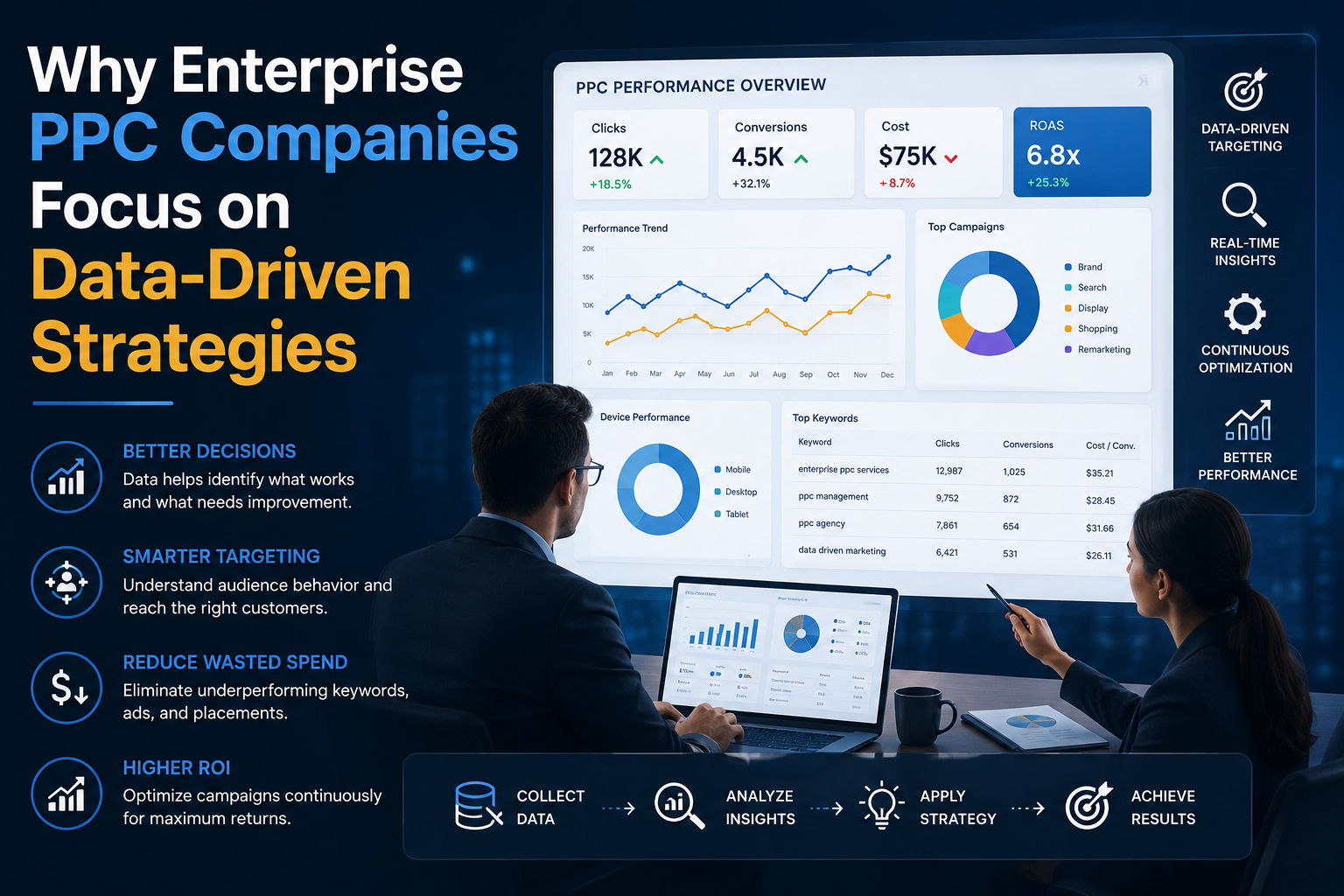
Running PPC campaigns at the enterprise level is very different from managing ads for small businesses. Enterprise brands usually handle large advertising budgets, multiple campaigns, different audience segments, and highly competitive keywords. Because of this complexity, guessing or using basic PPC methods is no longer enough. As per market research, businesses that rely on data-driven advertising strategies often achieve better conversion rates, stronger ROI, and lower wasted ad spend.
Today, every successful enterprise PPC company uses data to make smarter decisions. From keyword targeting to audience behavior tracking, data helps advertisers understand what is working and what needs improvement. As I have research, companies that focus on analytics and campaign optimization are more likely to scale profitably and generate long-term growth.
In this article, we will discuss why enterprise PPC management depends heavily on data-driven strategies and how these methods help businesses improve advertising performance.
What Are Data-Driven PPC Strategies?
Data-driven PPC strategies are advertising methods based on real campaign insights, customer behavior, and performance metrics instead of assumptions. These strategies use analytics, tracking systems, conversion data, and audience insights to optimize campaigns continuously.
An enterprise PPC agency studies important metrics such as:
- Click-through rate (CTR)
- Cost per click (CPC)
- Conversion rate
- Return on ad spend (ROAS)
- Audience engagement
- Device performance
- Geographic performance
- Search intent
Instead of making random campaign changes, PPC experts use this information to improve performance step by step.
As per my knowledge, data-driven advertising helps businesses reduce risk because every optimization decision is backed by real campaign data.
Better Audience Targeting Improves Conversion Quality
One of the biggest reasons enterprise PPC services focus on data is audience targeting. Showing ads to the wrong audience wastes money and lowers campaign performance.
Enterprise businesses usually target multiple customer groups across different locations and industries. Without proper data analysis, it becomes difficult to understand which audiences are converting and which are simply clicking ads without taking action.
As I have research, data-driven targeting allows businesses to:
- Identify high-converting audiences
- Exclude low-performing users
- Improve remarketing campaigns
- Create personalized ad experiences
- Increase lead quality
For example, an enterprise PPC company can analyze audience behavior and discover that mobile users from one region convert better during evening hours. Using this information, advertisers can adjust bids and scheduling to improve results.
This level of targeting improves conversion rates while lowering unnecessary advertising costs.
Data Helps Reduce Wasted Ad Spend
Wasted budget is one of the most common problems in paid advertising. Many businesses spend thousands of dollars on keywords, audiences, or placements that never generate sales.
As per market research, enterprise businesses lose a large percentage of their advertising budget because of poor campaign optimization and weak tracking systems.
This is why enterprise PPC management relies heavily on campaign data. PPC specialists regularly review:
- Search terms reports
- Negative keywords
- Low-performing ads
- Audience behavior
- Landing page engagement
- Bounce rates
These insights help advertisers remove weak-performing elements from campaigns.
For example, if a keyword receives hundreds of clicks but no conversions, data analysis clearly shows that the keyword is wasting budget. The advertiser can then pause the keyword or optimize it further.
As per my knowledge, reducing wasted spend is one of the fastest ways to improve overall PPC profitability.
Enterprise Businesses Need Accurate Conversion Tracking
Conversion tracking is one of the most important parts of enterprise AdWords management. Without proper tracking, businesses cannot measure campaign success accurately.
A data-driven enterprise PPC agency tracks actions such as:
- Phone calls
- Purchases
- Form submissions
- Demo bookings
- App downloads
- Newsletter signups
This tracking helps businesses understand which campaigns generate real business growth.
As I have research, many companies make the mistake of tracking only clicks and impressions while ignoring actual revenue data. However, clicks alone do not guarantee business success.
Data-driven strategies help businesses focus on meaningful conversions instead of vanity metrics.
For example, one campaign may generate fewer clicks but produce more qualified leads and sales. Another campaign may receive high traffic but no revenue. Without conversion tracking, businesses cannot identify these differences properly.
Smarter Keyword Optimization Improves ROI
Keywords are the foundation of PPC advertising. Choosing the wrong keywords can increase CPC and attract irrelevant traffic.
Enterprise PPC services use keyword performance data to improve targeting accuracy and campaign profitability.
A professional enterprise PPC company regularly analyzes:
- High-converting keywords
- Search intent
- Cost per conversion
- Match types
- Keyword trends
- Negative keyword opportunities
As per market research, high-intent keywords usually deliver stronger conversion rates because users already show buying intent.
For example, keywords like:
- “Enterprise PPC agency near me”
- “Best enterprise PPC services”
- “Enterprise AdWords management company”
often perform better than broad informational keywords.
Data helps advertisers focus more budget on keywords generating qualified leads while reducing investment in poor-performing searches.
Landing Page Data Helps Improve Conversions
Running ads alone is not enough. Landing page performance also affects PPC success.
Even if ads generate clicks, poor landing pages can reduce conversions significantly. This is why enterprise PPC management includes landing page analysis and optimization.
PPC experts review:
- Bounce rates
- User engagement
- Page speed
- Mobile responsiveness
- CTA performance
- Form completion rates
As per my knowledge, businesses often lose conversions because their landing pages are slow, confusing, or not aligned with ad messaging.
For example, if users click an ad about enterprise PPC services but land on a generic homepage, they may leave without converting.
Data-driven landing page optimization helps improve user experience and increase lead generation.
Automated Bidding Uses Real-Time Data
Modern Google Ads campaigns heavily depend on automation and machine learning. Automated bidding strategies use real-time campaign data to improve performance.
Enterprise PPC agency teams often use strategies such as:
- Target CPA
- Maximize Conversions
- Target ROAS
- Enhanced CPC
These bidding systems analyze user behavior, device data, search intent, location, and browsing patterns instantly.
As I have research, automated bidding becomes more effective when campaigns collect enough conversion data.
This allows advertisers to scale campaigns more efficiently while maintaining profitability.
Instead of manually adjusting every keyword bid, automation helps enterprise businesses optimize campaigns faster and more accurately.
Data Helps Enterprise Brands Scale Confidently
Scaling PPC campaigns without proper data can become risky and expensive. Many businesses increase budgets too quickly without understanding which campaigns are actually profitable.
A data-focused enterprise PPC company scales campaigns carefully by analyzing:
- Conversion trends
- ROAS performance
- Audience quality
- Geographic data
- Device performance
- Seasonal demand
This helps businesses invest more confidently in campaigns already generating strong results.
As per market research, businesses using data-driven scaling strategies often achieve more stable long-term growth compared to businesses relying on guesswork.
Competitive Analysis Improves PPC Strategy
Enterprise advertising markets are highly competitive. Businesses constantly compete for the same audiences and keywords.
Enterprise PPC services use competitor analysis tools to study:
- Competitor keywords
- Ad copy
- CPC trends
- Audience targeting
- Market positioning
These insights help advertisers identify opportunities and improve campaign strategy.
As I have research, understanding competitor behavior helps businesses avoid overspending while improving ad positioning and click-through rates.
Competitive data also helps brands create stronger messaging and unique value propositions.
Final Thoughts
Enterprise advertising requires more than basic PPC knowledge. Large campaigns involve complex targeting, high budgets, detailed reporting, and constant optimization. Because of this, successful businesses rely heavily on data-driven advertising strategies.
As per my knowledge, every professional enterprise PPC agency uses analytics, tracking, audience insights, and automation to improve campaign performance and reduce wasted spending. Data helps businesses make smarter decisions, improve conversion quality, and scale advertising profitably.
From keyword optimization to audience targeting and conversion tracking, data-driven enterprise PPC management creates a clear path toward better ROI and long-term business growth.
As I have research, businesses that continuously analyze campaign data are more likely to stay competitive and achieve stronger advertising performance in the future.
