

The mobile app landscape in 2026 looks nothing like it did five years ago. Users today expect apps that anticipate their needs, respond to their environment, and work flawlessly whether they’re on an iPhone, an Android device, or a tablet. If your business is still treating mobile development as a simple checkbox — just build it and ship it — you’re already falling behind.
Choosing the right mobile app development company is no longer just about writing clean code. It’s about finding a partner that understands the convergence of artificial intelligence, augmented reality, and cross-platform architecture, and knows how to use them strategically to drive real business outcomes.
The Business Case for AI-Powered Mobile Apps
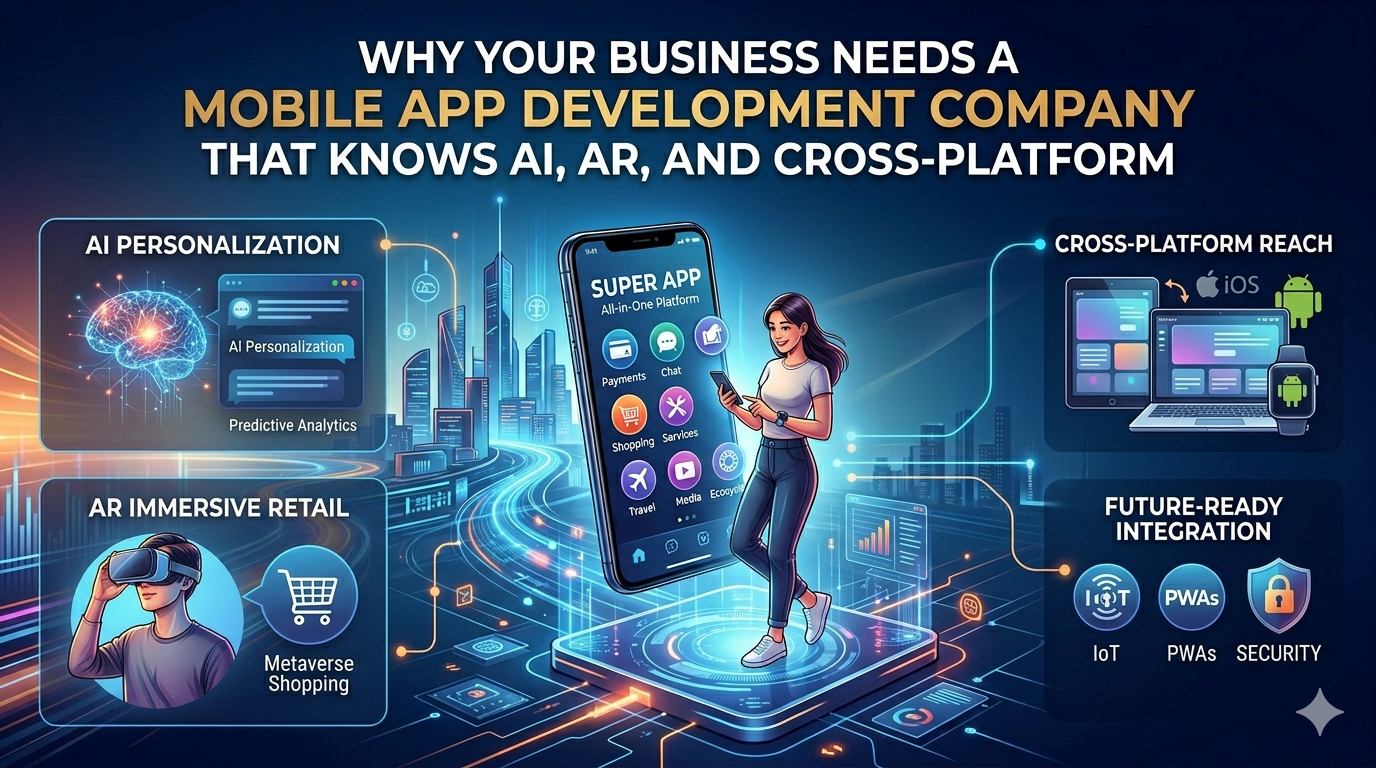
Artificial intelligence has moved from a buzzword into a genuine competitive advantage embedded directly into mobile experiences. Smart personalization engines, predictive search, real-time recommendation systems, and conversational interfaces are now baseline expectations in many industries — from e-commerce to healthcare to fintech.
When you work with an app development company that has deep AI capabilities, you’re not just getting a prettier interface. You’re getting an app that learns from user behavior, reduces churn by serving relevant content at the right moment, and automates repetitive tasks that previously required human intervention. AI-driven analytics embedded inside the app also give your team actionable insight into how people are actually using your product — not just what they clicked, but what they intended.
For businesses entering growth phases, this is the difference between an app that feels like a brochure and one that feels like a team member.
Augmented Reality Is No Longer Optional for Certain Industries
If your business operates in retail, real estate, interior design, manufacturing, or education, AR is rapidly shifting from a novelty feature to a core expectation. Customers want to visualize furniture in their home before purchasing. Healthcare trainees want to practice procedures in simulated environments. Field technicians want AR overlays that guide them through complex repairs without opening a manual.
The challenge is that AR development is genuinely difficult. It requires expertise in spatial computing, device sensors, rendering engines, and performance optimization — skills that most generalist development shops simply don’t have. This is why vetting your mobile application developers for AR competency matters as much as asking about their UI/UX portfolio.
A company that has shipped AR features at scale knows how to handle edge cases: poor lighting conditions, varying hardware capabilities, and the battery drain that comes with real-time rendering. These are not problems you want to discover after launch.
Cross-Platform Development: Speed Without Sacrificing Quality
Maintaining two separate native codebases — one for iOS and one for Android — is expensive. It doubles your development time, doubles your QA effort, and creates drift between platforms over time. In 2026, most forward-thinking businesses are moving toward cross-platform frameworks like Flutter or React Native to solve this problem.
However, cross-platform development done poorly produces apps that feel clunky on both platforms rather than native on either. The key differentiator is experience. A seasoned mobile app development company knows when to lean into the shared codebase and when to write platform-specific modules to preserve native performance and UX feel.
The best teams also architect cross-platform projects with scalability in mind — clean separation between business logic and UI layers, modular component libraries, and CI/CD pipelines that allow for fast, confident releases. This discipline pays dividends as your app grows and your feature roadmap expands.
What to Look for When Evaluating a Development Partner
Not every agency that claims expertise in AI, AR, and cross-platform development actually has it. Here’s how to separate signal from noise when evaluating your options:
Ask for live examples, not just screenshots. Any credible app development company should be able to walk you through deployed apps with AI or AR features and explain the technical decisions behind them.
Assess their product thinking. The best mobile application developers push back on requirements that don’t serve the end user. If every conversation is purely about implementation with no discussion of outcomes, that’s a warning sign.
Look at their post-launch track record. Launching an app is the beginning, not the end. Ask specifically about how they handle performance monitoring, iterative updates, and long-term support contracts.
Evaluate communication practices. Timezone gaps and communication breakdowns kill more projects than bad code. Understand how they structure updates, handle blockers, and involve your team in key decisions.
The Cost of Getting This Wrong
Businesses that partner with the wrong development team face a familiar and painful trajectory: an initial launch that’s underwhelming, followed by months of bug fixes, followed by an expensive rebuild with a new vendor. The sunk cost isn’t just financial — it’s the market time lost while competitors ship features and acquire users.
In 2026, the stakes are higher because user expectations are higher. People delete apps within seconds of encountering friction. An app built without AI-powered personalization, without thought for AR extensibility, or without a cross-platform architecture that allows rapid iteration is an app that will require a fundamental rethink sooner than you expect.
Final Thought
The mobile apps that win in 2026 are built by teams that think holistically — about technology, yes, but also about user behavior, business models, and long-term scalability. Finding a mobile app development company that brings genuine expertise in AI, AR, and cross-platform development isn’t about chasing trends. It’s about building something that actually works for your users and grows with your business.
Do your due diligence, ask hard questions, and choose a partner that treats your success as their own.
